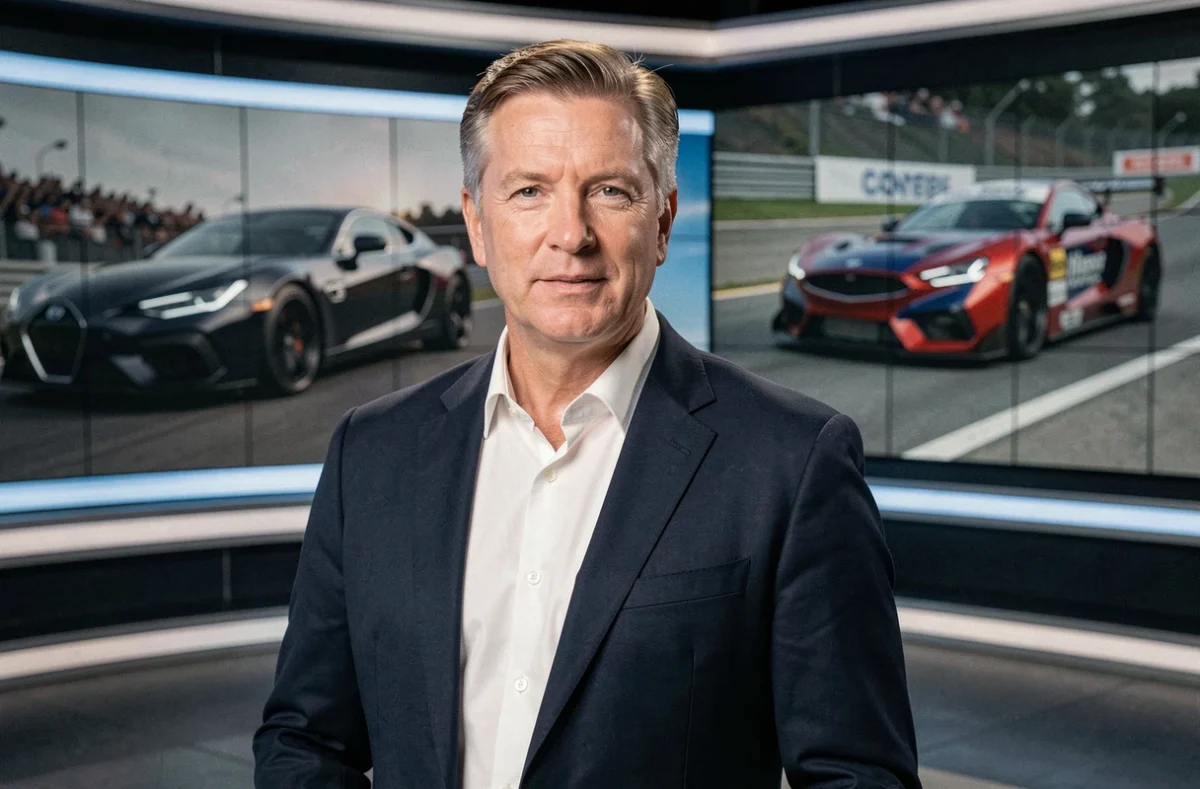
When you turn on M6 on Sunday morning to watch Turbo, you expect to hear the voice of Dominique Chapatte. Since the start of the 2024 season, the theme tune hasn’t changed, but the format of the show has shifted. The long-time host is still credited in the official cast on the channel’s schedule, yet several recent episodes have entrusted an increasing share of topics to other journalists.
Understanding what is happening requires distinguishing what M6 communicates from what is observed on screen.
Turbo without official announcement: the ambiguity maintained by M6
As of the date of writing, M6 has not published any statement confirming Dominique Chapatte’s departure. The professional schedule (pro.m6.fr) continues to display his name next to Turbo. The adjustments announced by the channel for the 2026 season pertain to other time slots, including the arrival of Julien Courbet and new event formats in the evening.
This helps to explain why why Dominique Chapatte is leaving Turbo M6 appears so frequently in online searches: the actual situation does not align with a binary scenario of departure or retention. The host is still there on paper, but his presence on air has diminished compared to previous seasons.
Turbo is not among the shows affected by the schedule restructuring. The channel classifies the program among its historical brands, alongside other established shows since the 1980s. This status protects the show from a sudden change, but does not prevent a discreet evolution of the cast.
Étienne Bruet and Cyril Drevet: the real sharing of roles in Turbo
Recent episodes show a distribution of topics among several journalists. Étienne Bruet and Cyril Drevet appear regularly on screen for reports, tests, and thematic subjects. Their presence is not new, but it now occupies a more visible place.
The distinction to be made is this: being credited as a presenter and being present on screen are two different things. Chapatte remains the name displayed in the credits. Other journalists cover field content, car tests, investigations on electric mobility, or economic topics related to automobiles.
This functioning resembles a gradual transition rather than a replacement. A classic pattern is observed in French television magazines: the long-time host retains the title while the new generation takes airtime, episode after episode.
What this concretely changes for the viewer
- The overall tone of the show remains automotive, technical, and aimed at the general public, but recent topics broaden the spectrum towards sociological and ecological angles, in line with the official program description
- Car tests are no longer systematically presented by Chapatte, which alters the public’s relationship to the judgment made on a model
- The duration and format of reports vary more from one episode to another, with longer segments entrusted to Bruet or Drevet
Dominique Chapatte at 76: a gradual withdrawal from automotive broadcasting
Chapatte himself has publicly mentioned the end of a cycle. The phrase “every adventure has an end,” relayed by the tabloid press, reflects an accepted stance. The journalist is preparing his exit without haste, which explains the absence of a sensational announcement from M6.
This gradual withdrawal protects both the show and its host. Turbo retains its brand, its time slot, and its Sunday audience. Chapatte avoids the scenario of a forced departure or a highly publicized replacement, which often generates more noise than benefits for the program.
The most telling precedent in the history of French automotive television remains that of time slot changes: altering the visibility of a program (time, duration, frequency) sometimes produces more effect on the audience than the change of presenter itself. M6 seems to be betting on editorial continuity rather than a publicity stunt.
Turbo M6 streaming: the format evolves beyond the airwaves
The show is available for replay and streaming on the 6play platform. This detail matters because it changes the way the audience consumes Turbo. People no longer necessarily watch it live on Sunday morning: they catch up on a specific topic, an electric car test, or a report on a trade show.
This fragmentation of consumption mechanically reduces the importance of the presenter as a meeting figure. Content takes precedence over the face that introduces it, especially for a younger audience accustomed to short video formats.
The official editorial promise of Turbo goes beyond simple car tests. The program description announces economic, ecological, and sociological topics related to mobility. This broad positioning allows the show to survive a change of presenter without losing its identity.
The departure of Dominique Chapatte from Turbo is neither confirmed nor denied by M6. What we observe is a show that increasingly functions as a collective of automotive journalists, with a long-time host gradually fading from the screen. For loyal Sunday morning viewers, the program remains the same appointment, carried by different voices and a spectrum of topics that expands season after season.